Carotid Artery Disease
When would you suspect carotid artery disease?
- Mode of presentation
- When a patient presents with a transient ischemic attack (TIA) or cerebrovascular accident (CVA), it warrants further
work-up for carotid artery and cardiac disease.
- Physical findings
- On auscultation, one may hear a bruit over the stenotic vessel
produced from flow through a narrowing. However, a completely occluded vessel will not produce a bruit, as
there is no blood flow.
- Risk factors
- Coronary artery disease, peripheral vascular disease, and carotid artery disease are all different manifestations of atherosclerosis. When one is present, others should be suspected.
Suspicion, and thus workups, for carotid artery disease should be initiated because of TIA or bruit in neck or because of the presence of another atherosclerotic manifestation, e.g., coronary artery disease.
What are the major risk factors for atherosclerosis?
Major risk factors for atherosclerosis include:
- Family history of vascular disease
- Hypertension
- Hypercholesterolemia
- Smoking
- Diabetes mellitus
What are the imaging options to investigate a suspected case of carotid artery stenosis?
- Carotid duplex ultrasound
- Carotid doppler is the initial procedure to evaluate carotid artery disease.
- High-frequency sound waves are used to view the blood vessels in the neck and to determine the presence of narrowing
in the carotid arteries.
- CT angiogram with reconstructed images provide exquisite details of cerebral vasculature.
- MRI angiography can provide the same details as CT angiogram.
- Carotid angiography:
- Angiogram is being replaced by CT and MRI angiography.
- Angiogram is invasive and is attendant with problems secondary to contrast.
|
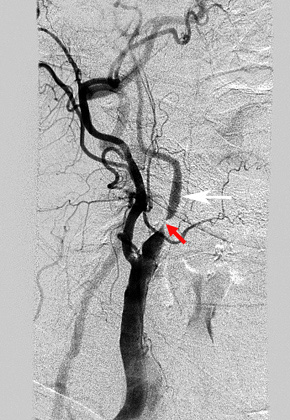
Internal carotid Artery stenosis
Red arrow points to site of occlusion .
Arrow points to collateral filling of the distal portion of the internal carotid artery on delayed film.
|
|
| |
|
|
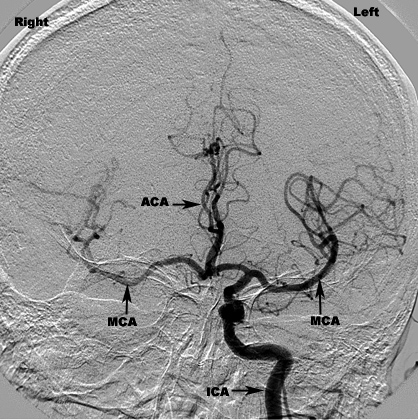
Internal carotid Artery stenosis
Left sided injection shows filling of right anterior and middle cerebral arteries indicating patent anterior communicating artery. [A good collateral system]
|
|
| |
|
|
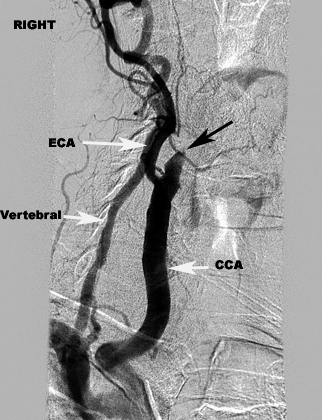
Internal carotid Artery stenosis
Black arrow: Occlusion of internal carotid artery
ECA : External carotid artery
CCA : Common carotid artery
|
|
Is there a role for interventional radiology in the treatment option?
Yes -- in carotid stenting
- Carotid stenting is a non-surgical option, under investigation, to treat carotid artery disease.
- A special catheter, with an umbrella tip is placed over a guide wire and directed to the stenotic area in the carotid artery.
- Once in place, a small balloon tip is inflated to dilate the artery.
- Then, a stent is placed in the artery to fit the size of the artery.
- Tiny filters capture any particles that are released and prevent them from going to the brain and causing a stroke.
- The stent stays in place permanently.